 An official website of the State of North Dakota

North Dakota launches Roughrider Coin, a token deposit for financial institutions
Bank of North Dakota (BND) and its partners launched Roughrider Coin, a U.S. dollar-backed token deposit designed exclusively for bank-to-bank transactions across North Dakota’s community banks and credit unions. BND will provide governance in an oversight role for Roughrider Coin which is operated through Fiserv’s Digital Asset Platform with issuance by VersaBank USA and verified on the Solana blockchain. Community banks and credit unions partnering with BND gain another method to move money, reducing friction and latency inherent in legacy systems. Read the full press release.
Why do financial institutions need a new transaction rail option?
North Dakota’s financial institutions are confronting a shift in how money moves. As digital settlement becomes routine and token deposits scale into mainstream infrastructure, community banks and credit unions face pressure to match the speed, availability and programmability now common in modern commerce. The state’s response is Roughrider Coin, a token deposit tranaction rail designed to deliver real‑time interbank settlement while keeping deposits and oversight within North Dakota’s regulated ecosystem.
Traditional systems such as ACH (Automated Clearing House) and wire transfers still carry much of the nation’s transaction volume, but they were built for business hours and batch cycles. That design introduces cutoff times, processing delays and manual overhead. Even newer options like FedNow and RTP (real-time transactions) have yet to reach full participation or ease of adoption across smaller financial institutions, with receive‑only configurations and significant integration demands limiting network effects. For institutions without 24/7 liquidity management and modern APIs (application programming interface), real‑time expectations can be difficult to meet.
Beyond the operational realities, the competitive landscape is changing. Analysts warn that traditional financial deposits may migrate toward private token deposit issuers as digital rails become embedded in payroll, remittances and commercial settlement. Without a credible real‑time alternative, smaller financial institutions risk losing transaction activity and the deposit relationships with their traditional customers.
What is Roughrider Coin, and what is it not?
Roughrider Coin functions as a permissioned, fully reserved asset used only by financial institutions, not retail consumers. It operates on the Solana blockchain to leverage high throughput and low cost, but it is issued and governed within a regulated framework, aligning digital speed with banking controls. BND’s objective is to modernize settlement and treasury operations for the state’s financial institutions without forcing them to build or manage blockchain infrastructure themselves.
Utilization of Roughrider Coin is 100% voluntary and limited to financial institutions. Community banks and credit unions will have the same modern settlement capabilities used by fintechs and decentralized platforms, allowing them to complete and retain deposit relationships with their customers.
BND’s mission is to partner with, not compete with, North Dakota financial institutions. Roughrider Coin is implemented help those institutions modernize and remain competitive as the local and global financial industry shifts to real‑time, always‑on transaction rails.
How does Roughrider Coin’s architecture work?
Through BND’s partnership with Fiserv, Roughrider Coin is issued as a permissioned asset, with built-in access controls, on Solana’s permissionless blockchain by VersaBank USA National Association, an OCC (Office of the Comptroller of the Currency)-chartered U.S. bank. Solana is selected for its performance and enterprise‑grade token controls, including freeze and clawback functions available through the Token‑2022 program extensions. Financial institutions transact using Fireblocks‑secured MPC (multi-party computation) wallets, with automated compliance policies and operational safeguards tailored for financial institutional use. Every token is backed one-to-one by U.S. dollars, with reconciliation through Fiserv and oversight from BND.
Financial institutions will manage all Roughrider Coin initiation, approval and settlement inside Fiserv’s Digital Asset Platform, which is accessible exclusively through the same BND operational channels that they use today for ACH and wires. The intent is continuity so staff can rely on existing workflows and back‑office systems without disrupting established transaction processes.
How is Roughrider Coin minted and burned?
Creation and redemption are automated around the movement of fiat currency into and out of designated accounts. Minting occurs only after a transfer from a financial institution’s operating account into a designated FBO (for benefit of) account is confirmed. Burning is triggered automatically when the token deposit reaches the receiving financial institution’s wallet, using an autoburn configuration that immediately initiates a smart‑contract instruction. The design keeps token balances low and aligns token positions with end‑of‑day cash targets, so currency value remains backed by deposits inside the regulated banking system.
How are risk, compliance and public assurances determined for Roughrider Coin?
Program follows GENIUS Act framework including reserve backing, attestations, public disclosures and compliance controls. Fiserv provides centralized compliance infrastructure, including Travel Rule enforcement, AML (anti-money laundering) and OFAC (Office of Foreign Assets Control) screening, and anomaly detection. These layers are presented as an effort to merge the transparency of on‑chain settlement with the obligations of banking compliance.
What are the economic benefits to financial institutions?
For financial institutions, the potential economic benefit is lower transaction cost, continuous liquidity and real‑time settlement without the burden of building or maintaining blockchain systems. The state anticipates strengthened financial infrastructure, deposit preservation across participating financial institutions, and greater resilience against shifts in transaction behavior.
What is the account structure behind daily flows?
Each participating financial institution maintains an FBO VersaBank Custody Account. Funds movement across the system is netted daily against an FBO VersaBank Concentration Account held at BND. Two rationales are offered for this structure. First, the combined accounts represent the one‑to‑one reserve backing that underpins the token. Second, the arrangement enables BND, in coordination with Fiserv, to push and pull ACH files among FBO accounts, supporting daily liquidity while keeping deposits inside participating institutions.
How does Roughrider Coin compare with existing transaction rails?
Roughrider Coin is positioned as near‑instant, with per‑transaction costs that are materially lower than wires and comparable to the cheapest batch items. There are no cutoff times. Settlement finality is immediate on‑chain, and transparency is near real‑time. Operational overhead is framed as lower, with fewer intermediaries relative to ACH operators or correspondent banks. Use cases align with treasury operations and loan payoff, rather than mass retail transactions. The risk profile emphasizes immutability and compliance, contrasted with fraud exposure, reversals, and FX (foreign exchange) risk inherent in traditional rails.
Side-by-side transaction rail comparison
| Feature | ACH | Wire Transfer | Roughrider Coin |
|---|---|---|---|
| Speed | 1–3 business days | Same day; 2–5 days international | Near-instant, 24/7/365 |
| Transaction Cost | ~$1/file + ~$0.01/item | $2–$35 | ~$0.01 |
| Cutoff Times | ~3 p.m. CT | ~4 p.m. CT | None |
| Settlement Finality | Batch delays | Final on posting | Immediate on chain |
| Transparency | Limited | Very limited | Real time |
| Operational Overhead | High | High | Low |
| Intermediaries | ACH operations | Correspondent banks | Minimal |
| Primary Use Cases | Payroll, bill pay | High-value transfers | Treasury, loan payoff |
| Risk Profile | Fraud, reversals | Fraud, FX risk | Immutable, complaint |
What does the future look like for North Dakota’s banking ecosystem?
Roughrider Coin represents a foundational advancement for North Dakota’s financial ecosystem. At the core of this initiative is a modern wallet infrastructure built as a long‑term, durable platform that will support the next 100 years of North Dakota’s banking industry. It enables institutions to modernize settlement, safeguard deposits and remain competitive in an increasingly digital financial world. By establishing this critical base layer today, North Dakota strengthens the resilience of its financial system and positions the state as a national leader in responsible, forward‑looking innovation.
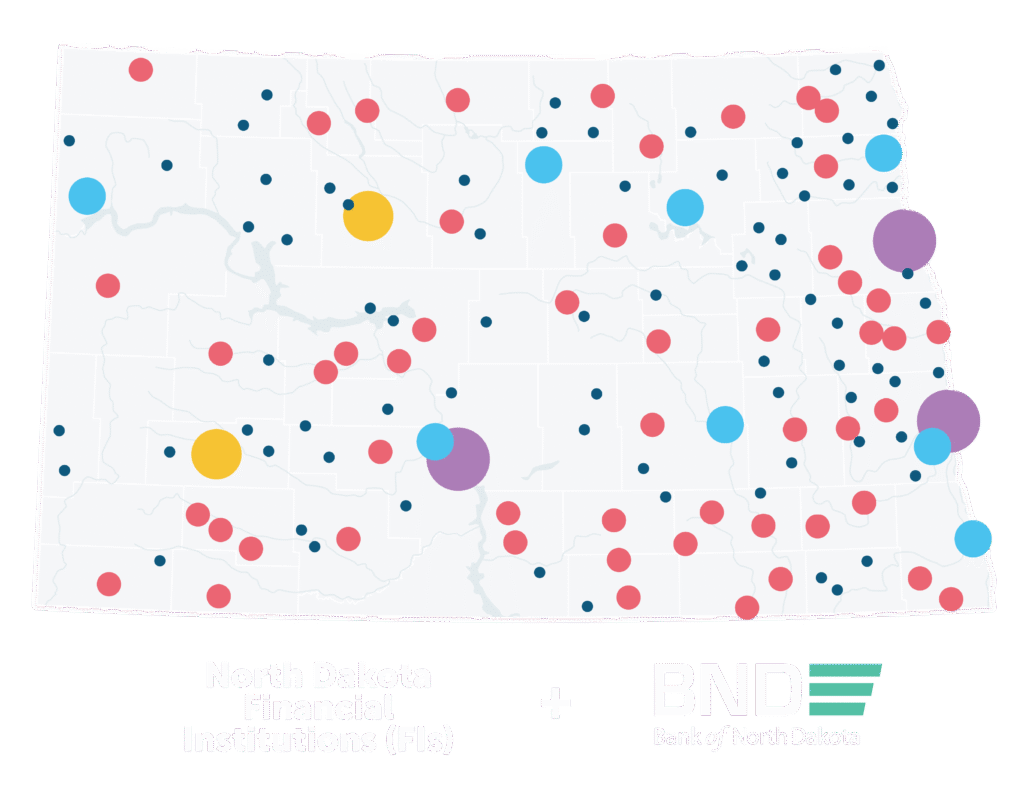
North Dakota’s Financial Ecosystem
North Dakota’s financial ecosystem blends a strong community banking footprint, a statewide credit union presence, and the unique advantage of the nation’s only state‑owned bank, BND.
Statewide footprint & scale
- North Dakota counted 61 FDIC-insured institutions holding $64.9 billion in assets as of Q1 2026.
- Branch-level deposits totaled $41.59 billion across 412 offices in the FDIC’s 2025 Summary of Deposits.
- Over time, statewide branch deposits rose from $8.78 billion (1994) to $41.59 billion (2025); the branch network peaked at 445 offices (2008) and stood at 412 (2025).
Community banks
- Community banks are the backbone of in-state banking: 67 community banks, 362 branches and 85.9% of deposits at bank branches (as of 12/31/2025).
- The Independent Community Banks of North Dakota (ICBND) exclusively represents these institutions, advocating statewide and providing education and shared services.
Credit unions
- North Dakota is home to 29 federally insured credit unions serving approximately 215,000 members with approximately $6.1 billion in combined assets (Q1 2026).
- Regionally, the Dakota Credit Union Association (DakCU) serves credit unions across North and South Dakota, reporting more than 562,000 members and approximately $11.6 billion in assets across the Dakotas (June 2025).
Unique advantage: BND partnership model
- BND, the nation’s only state‑owned bank, partners with local lenders rather than competing, expanding access to financing statewide.
- The North Dakota Industrial Commission oversees BND and consists of the Governor as chairman, Attorney General and Agriculture Commissioner.
Performance snapshots (banks, Q1 2026 medians)
- Tier 1 leverage: 10.13% | ROA: 1.29% | Net interest margin: 3.73% (FDIC State Profile medians).
Roughrider Coin FAQ
Press Releases
-
Industrial Commission Applauds Roughrider Stablecoin Announcement
Bismarck – The North Dakota Industrial Commission today shared its support for a new partnership between the Bank of North Dakota (BND) and its core […]
-
Bank of North Dakota and Fiserv Partner to Launch “Roughrider Coin,” North Dakota’s first Stablecoin
Launching on the Fiserv digital asset platform, Roughrider coin will help North Dakota financial institutions navigate a new financial frontier. MILWAUKEE – Fiserv, Inc. (NYSE: […]